Cocktail Hacker

    Hack What You Drink

Archive for the ‘Wrap Up’ Category

Adios Margarita!

Posted by Reese On October - 4 - 2008

I can officially say I am a changed man with regard to Mexico’s most well known spirit. This week has really been the epitome of what this site is about. I took a liquor I knew nothing about and for the most part disliked. Learned what I wanted about it, experimented with one of its classic incarnations, and grew from the experience. So, what all did I learn this week?
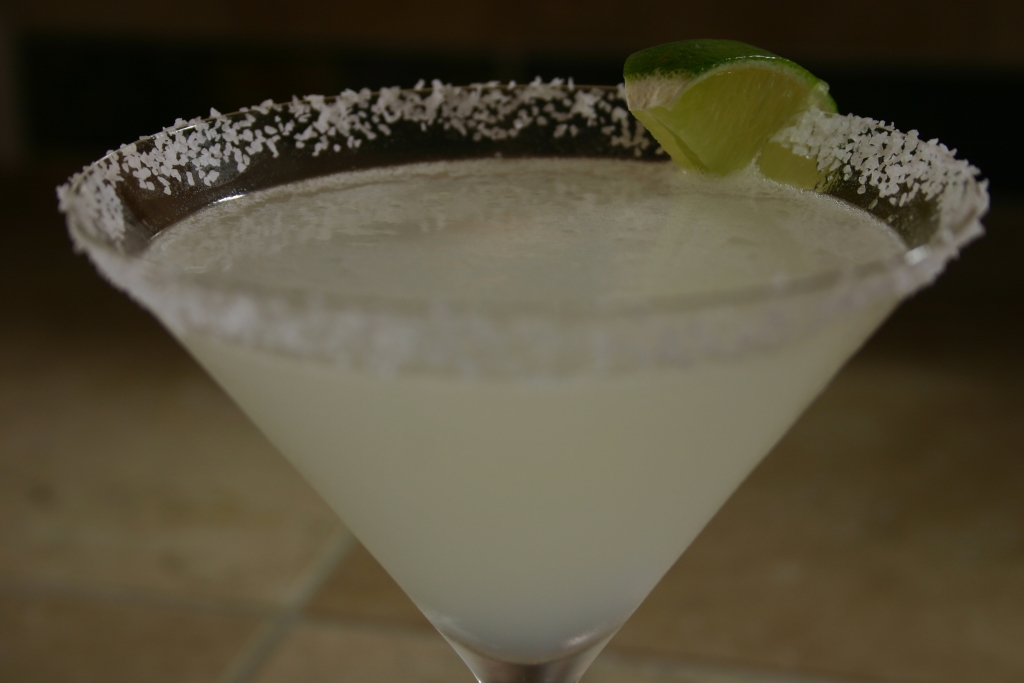
Let’s start with the cocktail recipes. I started the week with the recipe recommended, a ratio of 3 parts Tequila, 2 parts Cointreau and 1 part Lime Juice, or 3:2:1 (I’ll use this notation in this post when comparing recipes as it makes the discussion flow better. Note though that with these proportions you should aim for 4-5 ounces of final mixed drink, adjust accordingly). Roberts recipe is very well balanced and a very good drink, but it wasn’t exactly what I was looking for. The tequila seemed to be covered too much by the Cointreau and the resulting drink was a bit too sweet for me.

So I tried the recipe I found in my 1974 copy of Mr Boston’s next, namely a 3:1:2 ratio. This is more what I picture a Margarita to be, more lime flavor and not quite as sweet. Problem is this one is a bit overpowered by the lime. Still not exactly what I’m after. Soooo….I mixed up a recipe in one of the books my Aunt Ronnie sent me, Cocktails by Jeremey Harwood [Referer Link]. Jeremy’s recipe calls for a ratio of 3:1:1, which seemed like just what I was looking for. So I mixed one up. It’s at this point I should tell you a bit about my testing methodology. Rather than drinking 6 or 7 cocktails in one sitting I mix mini drinks. In this case I was using teaspoons as my parts. Also, I was using the ingredients at room temperature and not using ice. Which when making cocktails is never the right answer. So when I mixed up the mini, room temp version of this recipe I thought I had truly found my winner. The tequila shined through nicely and the other ingredients still played their part. Once all my testing was done I mixed up a full size version using ice and the proper technique and what I found was most interesting. The drink was completely different. The lime and sweetness were very muted and drink was no longer my favorite.
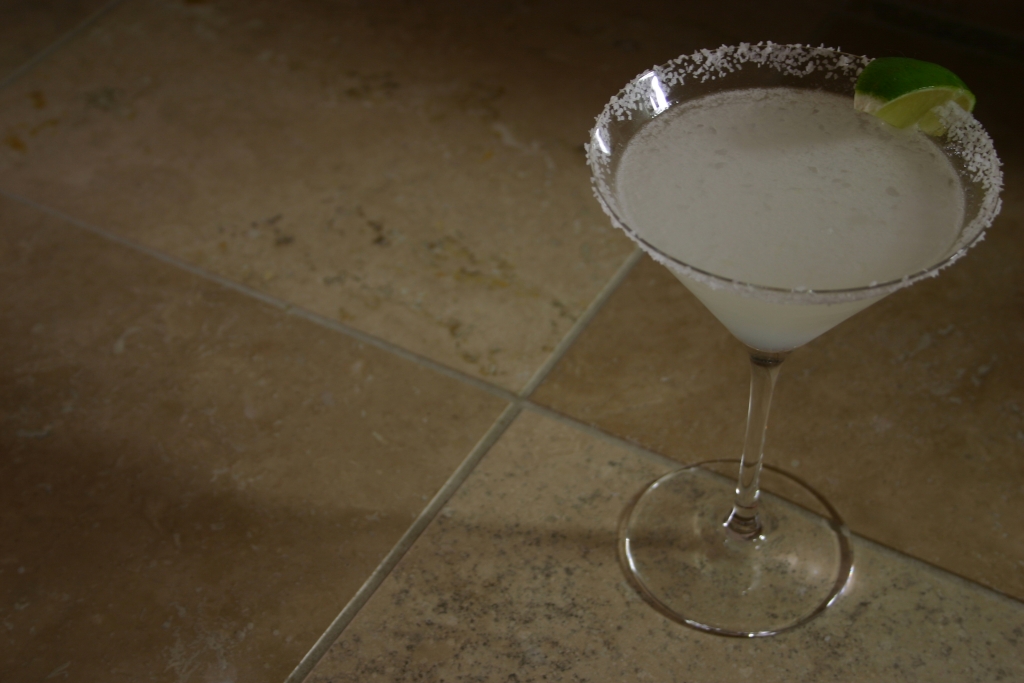
Back to the drawing board. I turned to the recipe in the Difford’s Guide, 2:1:1. This, my friends, was the answer I was looking for. The tequila was strong enough to shine through wonderfully but the lime and Cointreau balanced out the flavors. I’d strongly suggest this as a starting point for anyone looking to experiment with the Margarita. There is one tweak I’d suggest you make though, the Tequila.

Hess and other recipes suggest using a blanco or silver Tequila when mixing Margaritas. On that advice I picked up a bottle of Hornitos Plata. This Tequila is amazingly smooth and works very well to introduce someone to Tequila. The reason it’s such a good introduction though is also part of its down fall in this cocktail. It’s too smooth, the Tequila flavors don’t shine through like I wanted them to. Sean, my resident Tequila master, suggested I try a reposado instead. So at his suggestion I next picked up a bottle of Milagro Reposado. We mixed this up in the same recipe and that solved the over smoothness problem. The cocktail is still very smooth, but the Tequila flavors are more pronounced. So my suggested tweak is to try a reposado in this cocktail.

Next came the question of salt or no salt. I personally prefer no salt, doesn’t really add much for me. But there are a lot of people that really like the additional salt. So, my recommendation is, if possible, ask the drink’s intended recipient before mixing. Or if you’re mixing a tray load for a party try Hess’ suggestion and salt half the glass’ rim. This will let those who like salt have some and others can easily avoid it. One final tip that I picked up from Hess’ video is that when salting a glass run the lime around the outside edge of the glass only. Then when you apply the salt you won’t get any inside the cocktail prematurely.
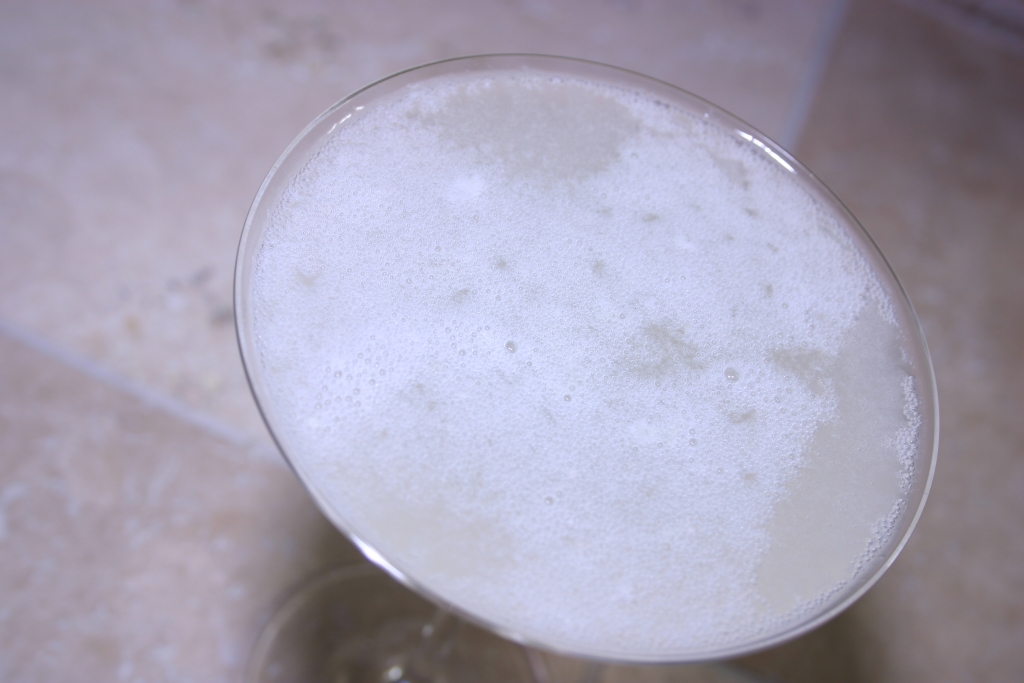
So I’ve rambled for quite a while in this post, but I have a couple more items to add. I’ve been reading “The Joy of Mixology” by Gary Regan for the past couple weeks. In the section about champagne cocktails Regan suggests topping some classic cocktails with a bit of champagne to add an interesting twist and mentions that it works particularly well with the Margarita. Indeed it does. I enjoyed mixing up my chosen 2:1:1 Margarita and adding about one to one and a half ounces of champagne on top. The resulting cocktail has a wonderful effervecense and the flavors stay true to the Margarita. Certainly give it a try. I was able to find some very small bottles of champagne that work great in this application.

One last interesting tweak. Sean, as I mentioned earlier, is my resident Tequila master. As such, he likes his Tequila straight up. So we went looking for a Margarita recipe that captured both the spirit of the cocktail and allowed the enjoyer to appreciate the flavors of the Tequila as well. Using a 6:1:1 ratio we were able to include the lime and Cointreau flavors in the background while bringing the Tequila flavor to the forefront. This recipe truly is all about the Tequila and along with that you should use an appropriately excellent Tequila. For our experiment we used Patron Anejo which worked wonderfully.

Enjoy your Margaritas. I look forward to more experiments like this week. As I said I’m a changed man.
Gin and Tonic – Wrap Up

Posted by Reese On September - 27 - 2008

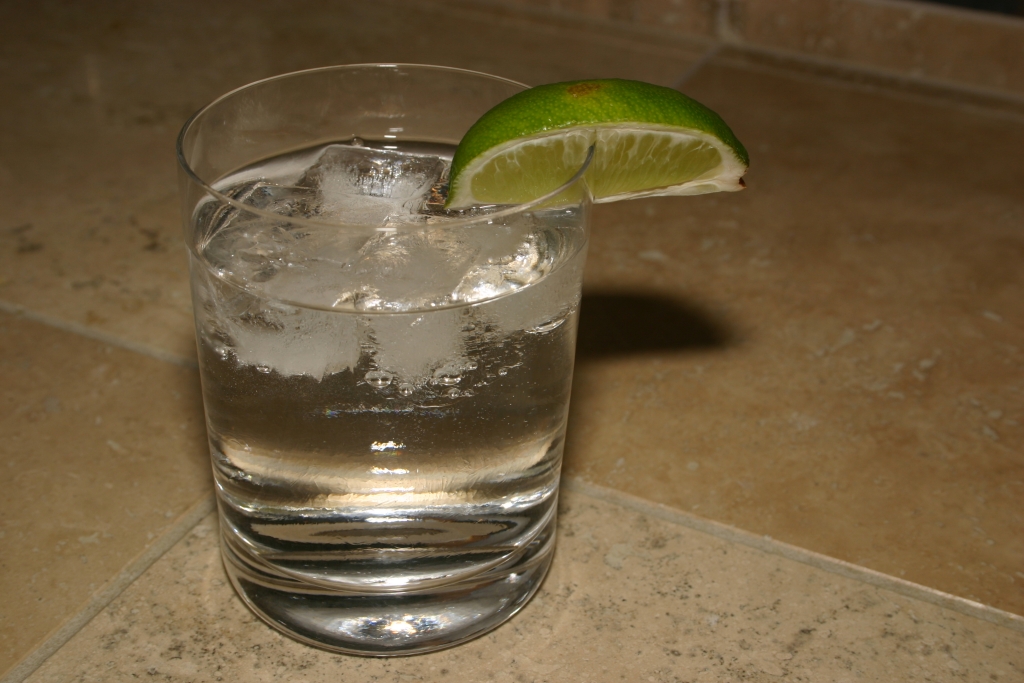
The greatest thing I discovered this week experimenting with the Gin and Tonic was a renewed love of my first favorite cocktail. The Gin and Tonic is an exercise in simplicity. Two ingredients and a twist of lime. But, as we showed in our tonic tasting just because the Gin and Tonic is simple doesn’t mean its easy to perfect. In our reviews we suggested some tonics to get you started. But what about the gin?

Like the Tom Collins, the perfect gin for this cocktail is extremely subjective. When I’m mixing with a store bought tonic I like to go with a lighter flavor gin that’s not going to over power the flavors of your chosen tonic. One of my favorites is Indigo. It has a great citrus forward flavor that plays nicely with the tonic. If you step up to a more powerful tonic, like our homemade version, you’re going to need a more powerful gin to balance out the flavors. For G&Ts with the homemade tonic I’ve been reaching for gins with a stronger juniper punch. Juniper Green is working well as are the couple from Bendistillery that I have in my collection. To generalize match your gin with your tonic. The resulting drink will be more balanced and the flavors will play off each other better.

Finally the garnish. In most cocktails the garnish may add a touch of flavor, but not much. It’s there as a cocktail decoration. In the Gin and Tonic the garnish, a lime wedge, not only adds visual appeal but also a lot of additional flavor. And, although I love my garnish squeezed into my cocktail, not everyone does. So, hang a lime wedge on the glass and let your guest apply it if they so desire. I’m hoping I don’t need to say this but I will just to be sure. Don’t drop the unsqueezed lime into the drink before you give it to your guest. No one likes having to fish their lime out of the drink just to squeeze it back in.

The Tom Collins – In Summary

Posted by Reese On September - 20 - 2008

Sadly, I’ve not had the time I like to spend experimenting fully with this cocktail this week. But, on an up note, I have a wealth of prior knowledge to draw from. There are a few points I’d like to make about the Collins. The first being Gin is but one base spirit that can be used. A Vodka Collins, Rum Collins or even a Whisk(e)y Collins are quite tasty. I highly recommend making a Collins with your favorite base spirit. I’m betting you won’t be disappointed.

The next point is one of construction. Nearly every Collins recipe you run across will state that you should “combine over ice and top with soda”. Now, were I making this cocktail as a bartender I think this would definitely be the best method as its the quickest and will yield near absolute consistency given your ice remains the same size. For home preparation however I advocate a different method. When I build these I do the following: 1) Combine spirit, syrup and juice in a glass. 2) Swirl briefly to combine. 3) Fill glass to about 1-1.5″ from the top with soda water. 4) Add ice cubes slowly to fill remaining space. The resulting cocktail will not require stirring as pouring in the soda has effectively done that for you. Additionally there won’t be as much fizzing since you’re adding the ice at the end. I’m guessing that purists will tell me that this isn’t the “right” way to build this cocktail, but I’m not making it for them so :P.

Now for the selection of gin. As with most cocktails I’ll recommend you first try your favorite gin, it is your favorite after all. When I’m building this cocktail I reach for a citrus forward gin. I think with this choice the gin’s flavors and the lemon blend nicely and make for a very harmonious tipple. My choice if I’m just looking for a refreshing summer drink to quench my thirst is Baffert’s Gin. It’s very cheap which makes it a great choice if you’re going to be serving this at a party and I think you’ll really be surprised by the flavor. For such an inexpensive spirit its really very good. If I’m wanting to up the ante I bit I pull down my bottle of Indigo Gin. Again a citrus forward gin, but a touch more refined than the Baffert’s. All of that aside I don’t think I’ve made a Tom Collins at home with any gin that I haven’t liked.

Finally, the Tom Collins while dining out is always a roll of the dice. Generally, unless you’re at a restaurant with a great bar, you’re going to get gin, sour mix and soda water. And, as you may have guessed, the gamble comes in the form of the sour mix. There are some really great sour mixes out there, don’t get me wrong. Are they a replacement for fresh juice and simple syrup? Most definitely not, but they’re good for what they are, shelf stable sweetened cirtus juice. There are, however, some really terrible sour mixes out there as well. I went out with my cousin for dinner on Monday (Thanks again for dinner Mike!). The Tom Collins I ordered was really very good. Good enough in fact that I asked the waitress whether it was made with lemon juice or sour mix. Sour mix it was. In retrospect I should have known seeing as you couldn’t see any lemon juice pulp in the drink, but it was pretty damn good. So give it a go some time. You may be pleasantly surprised, and, if not, don’t order one there again.

The Tom Collins truly is one of my favorite summer drinks. It’s extremely refreshing and has enough liquid (other than alcohol) in it that you’re actually going to rehydrate yourself a bit. As with other cocktails we’ve covered here, I must pass on my warning. These are very easy to drink. Two, Three, Seventeen, all go down very easily. With that I leave you for another week fellow hackers. Enjoy your Collins. I certainly will.

Negroni Addio!

Posted by Reese On September - 13 - 2008

I began this week’s explorations with a bit of trepidation. I had bought my bottle of Campari a couple months ago and hadn’t done much with it. In my early reading on the aperitif I had found that people often ordered a Campari and Soda, so I decided that was as good a place as any to start. I was not particularly impressed. The drink was tremendously bitter, but despite this I could taste the spirit’s potential. So on the shelf it went in anticipation of a delicious cocktail in which to use it.

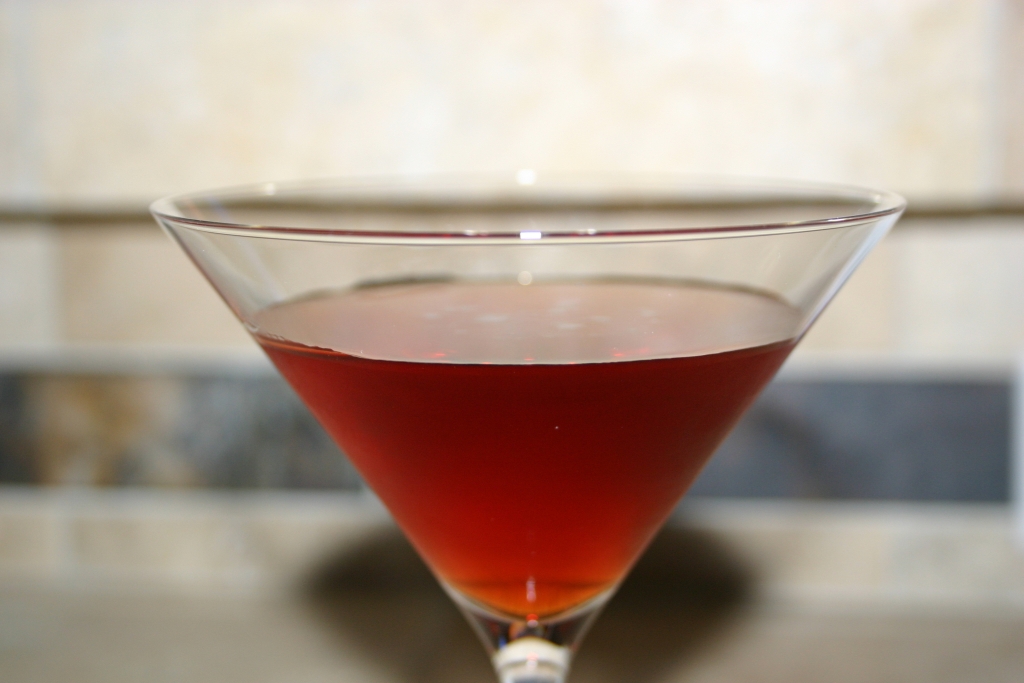
The Negroni turned out to be just such a cocktail. Using the 1:1:1 classic recipe you end up with a cocktail that has great flavor, a nice level of bitterness and perfect balance. Were I simply looking for a good recipe for this cocktail I would happily stop here. I, however, was on a mission for a great recipe. So I continued my hunt. I next tried a recipe I had found in a thread on eGullet, the Cinnabar Negroni as served at Cinnabar in Glendale, CA.

Cinnabar Negroni
2 oz Campari

1 oz Gin

1 oz Sweet Vermouth

2 dashes Orange Bitters

This too is a good recipe, and strangely isn’t too bitter from the additional Campari. The addition of orange bitters, Regan’s in my case, didnt’ seem to add much in this recipe. It did,however, give me the idea to try them with the classic recipe. What I found out from this subsequent experiment is that orange bitters truly make this cocktail. You can really taste them with the decreased Campari and they add a wonderful citrusy complexity to the drink. Another recipe I tried was described as a Smoother Negroni in the eGullet thread.

Smoother Negroni
2 oz Gin

1 oz Sweet Vermouth

1/2 oz Campari

This is, doubtless, a very good cocktail, but I don’t think I can really call it a Negroni. When you’ve increased the Gin so much and decrease the Campari comparably the resulting cocktail is fundamentally different. Seems that Gary Regan had similar feelings with his modified Negroni that he thus renamed the Valentino.

Gary Regan's Valentino
2 oz Gin

1/2 oz Sweet Vermouth

1/2 oz Campari

Each recipe that I tried was very good, but I kept coming back to the classic recipe as my hands down favorite. I do make the aforementioned change of adding orange bitters which I think really heightens this cocktail. As for shaking versus stirring I found that the flavor is the same either way. You may get a touch more dillution with shaking from the ice particles, but the main difference you’ll notice is the appearance. The shaken cocktail is quite cloudy and remains so for a while after serving. Because of this, a stirred Negroni is my choice. Finally, you can serve this cocktail up or on the rocks. I think the up version is a more elegant cocktail, but if the bitterness is too bold for you initially try it over ice and let it dilute a bit. I think you’ll be pleasantly surprised. With those notes I present our version of this cocktail.

The Cocktail Hacker Negroni
[Ingredients]
1 oz Gin

1 oz Sweet Vermouth

1 oz Campari

2-3 dashes Regan's Orange Bitters
[Directions]
1) Combine ingredients in shaker bottom or pint glass

2) Stir until well chilled

3) Strain into a cocktail glass

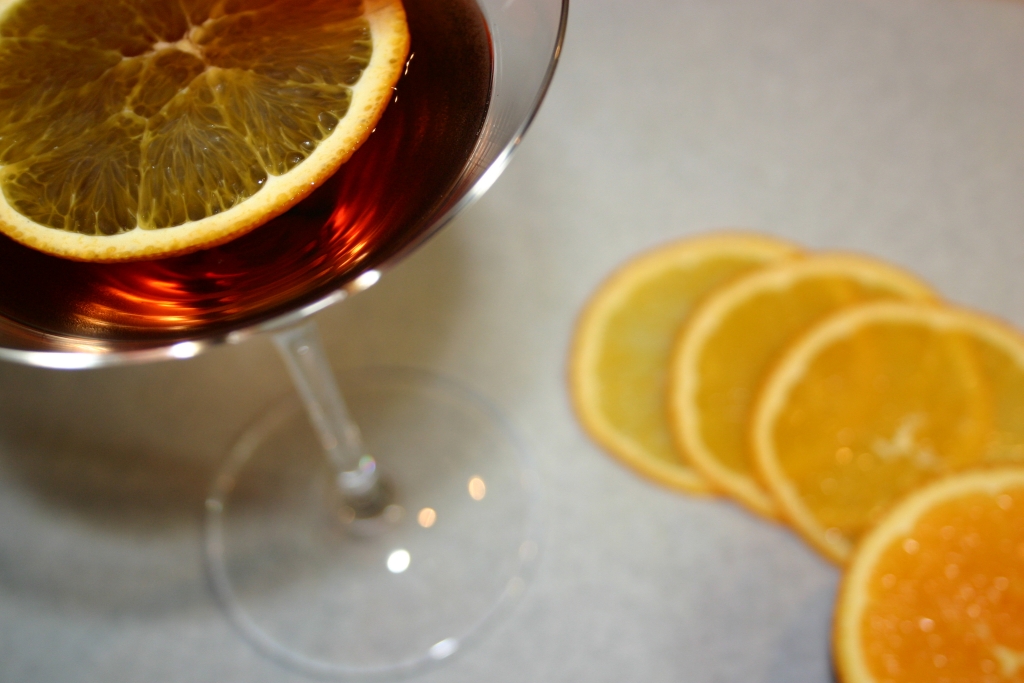
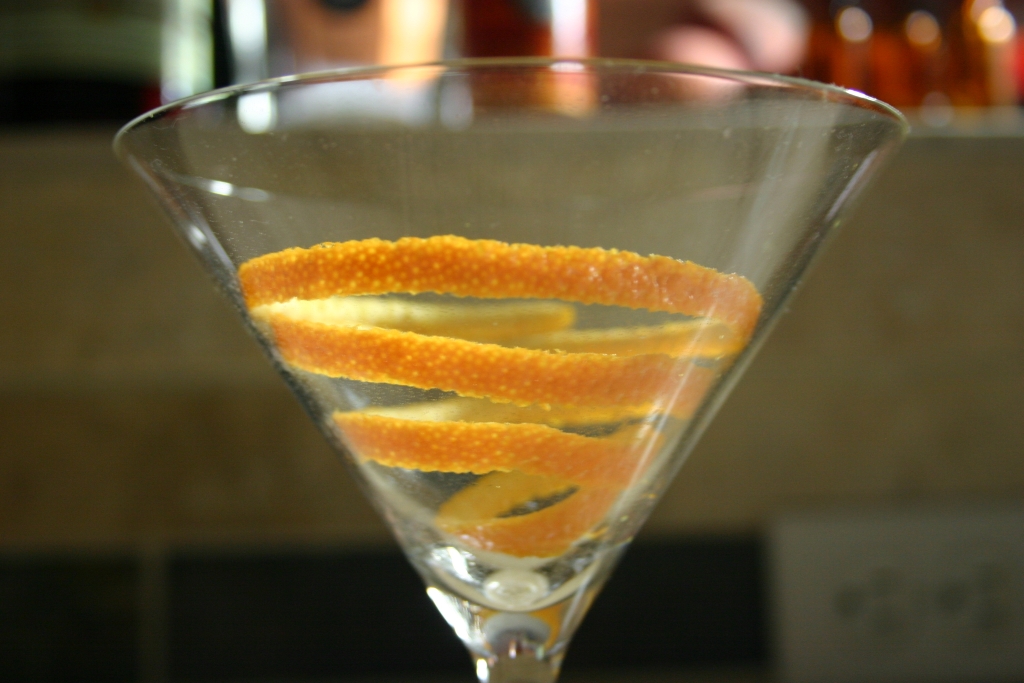
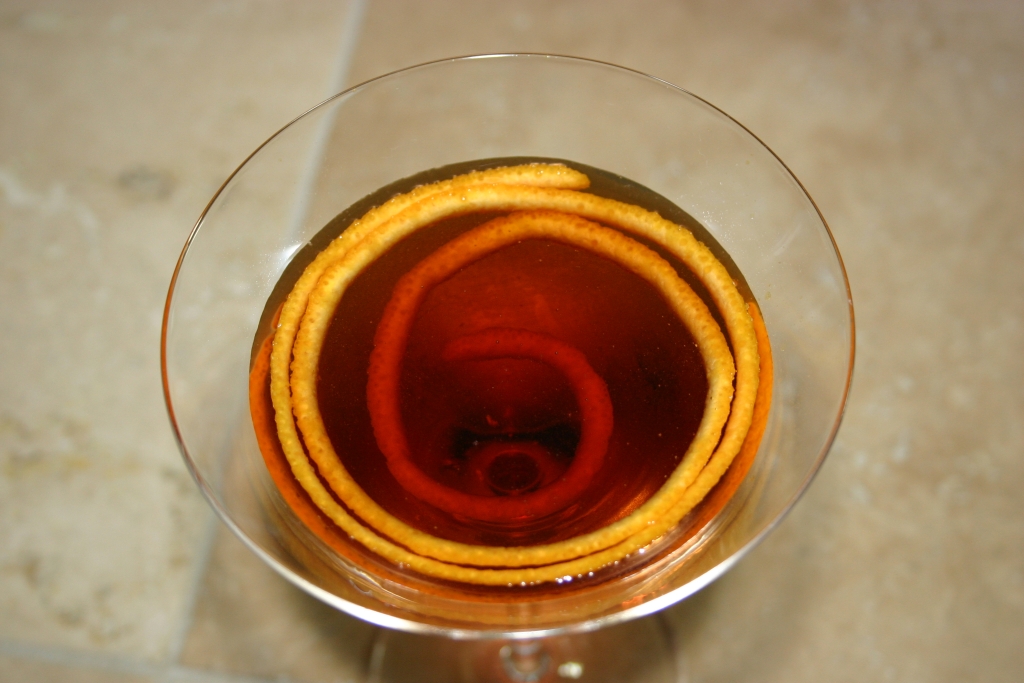
My other focus for the week was garnishing. I tried a technique I read about in “The Joy of Mixology” by Gary Regan. The technique called for zesting a lemon (orange in my case) and lining a cocktail glass with the resulting zest. It looked like a good plan in the preliminary stages, but when I added the cocktail the zest floated and messed up the look. Not sure how to correct this, but I’ll have to try again with another cocktail. The other garnish I tried, and loved, was to use a v-slicer to cut very thin slices of orange and float one on the top of the cocktail. I really like the look of this garnish and if you get an orange with a not too bitter pith you can eat the whole thing, which is fantastic. The one garnish that was recommended that I didn’t get a chance to try was flamed orange zest. It’ll have to be next time.

So, despite my initial thoughts that this may be the first cocktail on the site that I didn’t like, I found another gem. This cocktail is colorful, has great flavors and is wonderfully complex. I can easily say that it is well worth a trip to the liquor store for a bottle of Campari. I took a ton of pictures this week and they’re all posted in the Flickr pool.

A Tearful Goodbye to the Whiskey Sour

Posted by Reese On September - 6 - 2008

I’ve spent this week experiencing the nuances of the Whiskey Sour and it is with more than a bit of reticence that we must move on. This cocktail in its many forms is truly wonderful. I’ve tried all manner of combinations this week and can really say I’ve enjoyed them all.

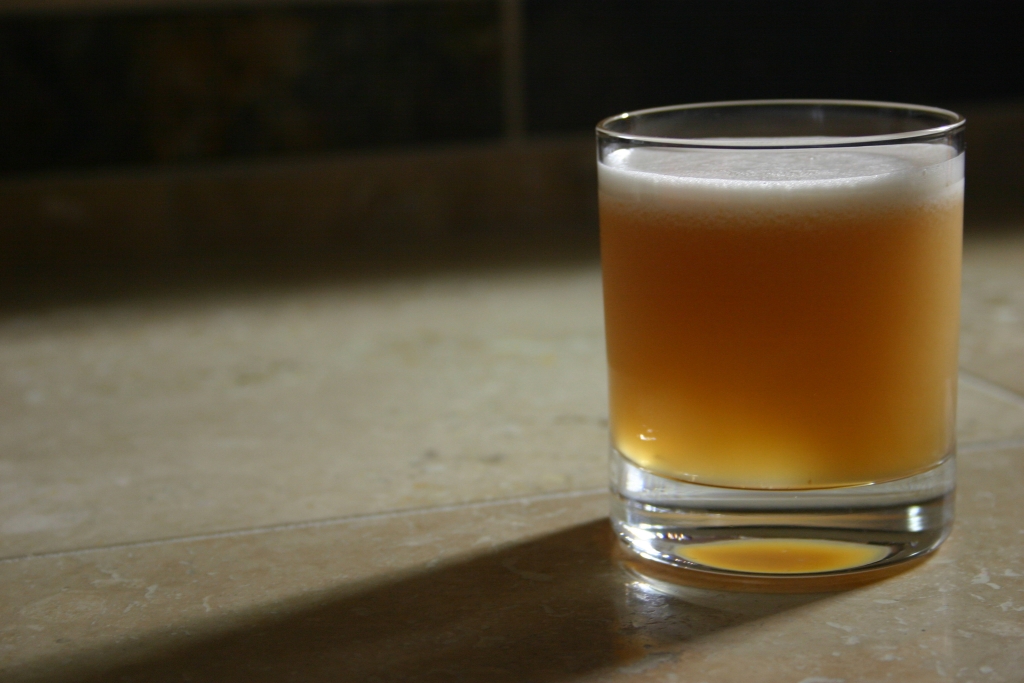
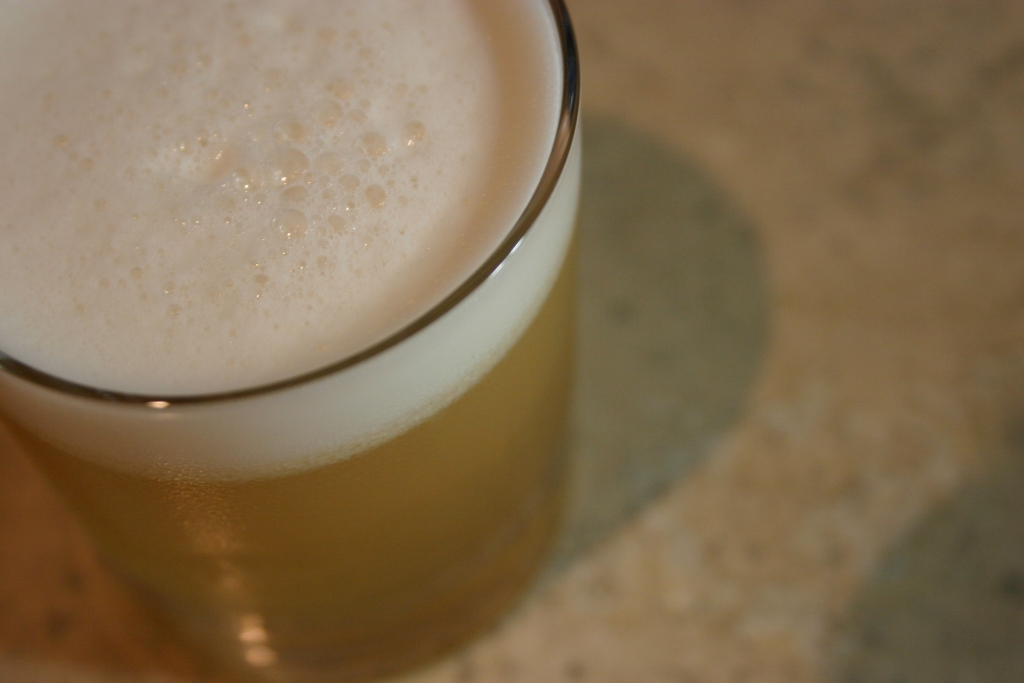
With and without egg white being the first. Does the egg white add something? Most definitely. It adds a silkiness to the mouth feel of this drink that is not attainable any other way. Beyond that it adds uniqueness. I assure you that if you serve a cocktail to a friend with this rich foam floating on top and explain its creation they will be awed. Is the egg white required? Absolutely not. Although it adds a lot to the texture of the drink it doesn’t really do anything for the flavor. So, give it a go both ways and decide what you like. Although, as I mentioned earlier in the week older egg whites may give your cocktail some fridge funk flavor, so buy some fresh eggs for this.

My next big change was to switch up the base spirit. I tried bourbon, rye, a bourbon/rye mixture, and even single malt scotch. Which was the best? Well…that’s not so easy. They all have their strong points. The bourbon gives the drink a sweet smoothness, the rye a spiciness and the scotch smokiness. Not surprisingly what each lends to the cocktail is the strong points of the flavor profiles of each spirit. So again I have to be vague in my suggestion. Use the whiskey that you like best and you’ll be supremely happy with the results.

Finally the bitters, sugar and lemon. Some of the recipes, most in fact, didn’t call for bitters at all. I feel this is an error. Bitters really bring out the flavor of whiskey, but you have to be careful, too much and they can smother those flavors just as easily. My favorite recipe, which is below, uses Fee Brother’s Bitters and Regan’s Orange Bitters together. I really like the spices that the Fee Brother’s Bitters offer more than Angostura in this application and I feel the Regan’s Orange Bitters play extremely well with the lemon juice. The recipe we started the week with called for 1/2 ounce of rich syrup, or the equivalent of 1 ounce of simple syrup. The resulting cocktail was too sweet for my tastes. My final recipe reduces the sugar to 1/2 ounce of simple syrup. Finally the lemon. I didn’t change a thing. This ratio to the base spirit I think is perfect. The only thing I’ll emphasize here is to use the freshest lemon juice you can. If you can’t or don’t want to fresh squeeze juice for every cocktail squeeze a bunch a the beginning of the week and keep it refrigerated. It won’t be as good as supremely fresh squeezed juice but it will be a damn sight better than the stuff from concentrate.

So now I present to you my final Whiskey Sour recipe. Do with it as you please and by all means, Hack It!

Cocktail Hacker Whiskey Sour:
[Ingredients]
2 oz Whiskey (Your Choice)

1 oz Lemon Juice

1/2 oz Simple Syrup

1/2 Fresh Egg White

1 Dash Fee Brother's Old Fashioned Bitters

2 Dashes Regan's Orange Bitters
[Directions]
1) Combine ingredients in a shaker without ice

2) Shake for 10-20 seconds to foam egg white

3) Add ice to shaker

4) Shake until thoroughly chilled

5) Strain in to an Old Fashioned Glass