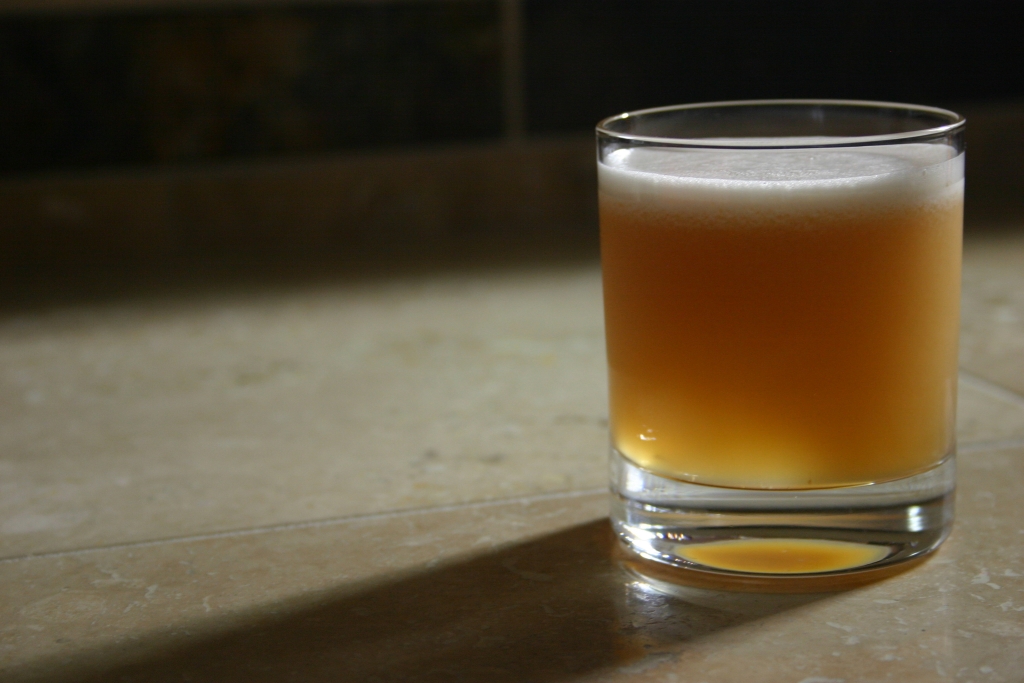
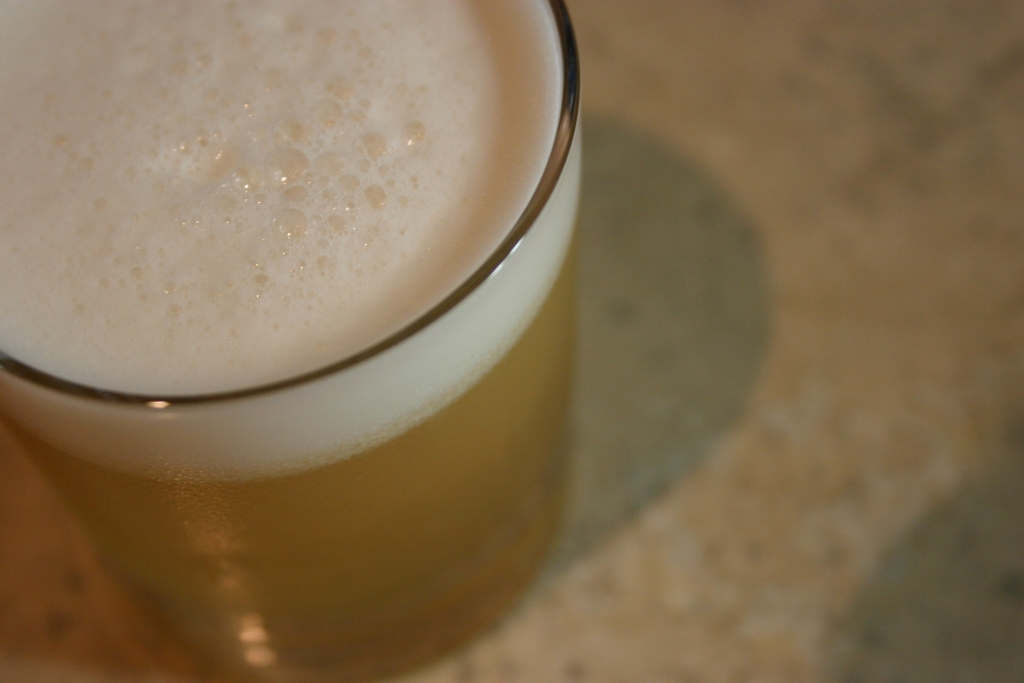
Cocktail Hacker

    Hack What You Drink

Archive for the ‘Recipes’ Category

Tom Collins

Posted by Reese On September - 14 - 2008

This week’s cocktail is one of my absolute favorites. When I first started enjoying cocktails my go to drink was always the Gin and Tonic. This drink is a great choice when out and about as most restaurants will have passable gin and tonic in their bar. At home you can craft an even more perfect G&T, but we’ll leave that for a later week. A couple years ago I found out about the Tom Collins and ever since it has become the equal of the G&T at least while I’m at home. This is the first Fizz style cocktail we’ve covered here at Cocktail Hacker and the key ingredient you’ll want to pick up that we haven’t used before is soda water. There are a few options for this ingredient and I’ll explain them later this week.

So, where did the name Tom Collins come from? Well, there is some confusion on that one. It is said that the cocktail started it’s life as the John Collins, named for the waiter at London’s Limmer’s Hotel of the same name. David Wondrich lists a recipe for this cocktail in his book “Killer Cocktails”. The drink has a base of Genever Gin, or Holland Style Gin. Since then the drink’s name has morphed into Tom Collins. The thinking behind this is that the name change came along when the drink’s primary spirit switched over to Old Tom Gin, which was a sweetened aromatic gin. Fear not though, English Dry Gin works perfectly well when constructing this cocktail.

Here is the recipe I’ve always used. As is customary I’ll spend the week trying other versions and will come back with what’s the best.

Tom Collins
[Ingredients]
2 oz Gin

1 oz Lemon Juice

1/2 oz Simple Syrup

Soda Water
[Directions]
1) Combine the gin, lemon juice and syrup in a tall glass with ice

2) Stir to combine

3) Top with soda water to fill glass

Negroni Addio!

Posted by Reese On September - 13 - 2008

I began this week’s explorations with a bit of trepidation. I had bought my bottle of Campari a couple months ago and hadn’t done much with it. In my early reading on the aperitif I had found that people often ordered a Campari and Soda, so I decided that was as good a place as any to start. I was not particularly impressed. The drink was tremendously bitter, but despite this I could taste the spirit’s potential. So on the shelf it went in anticipation of a delicious cocktail in which to use it.
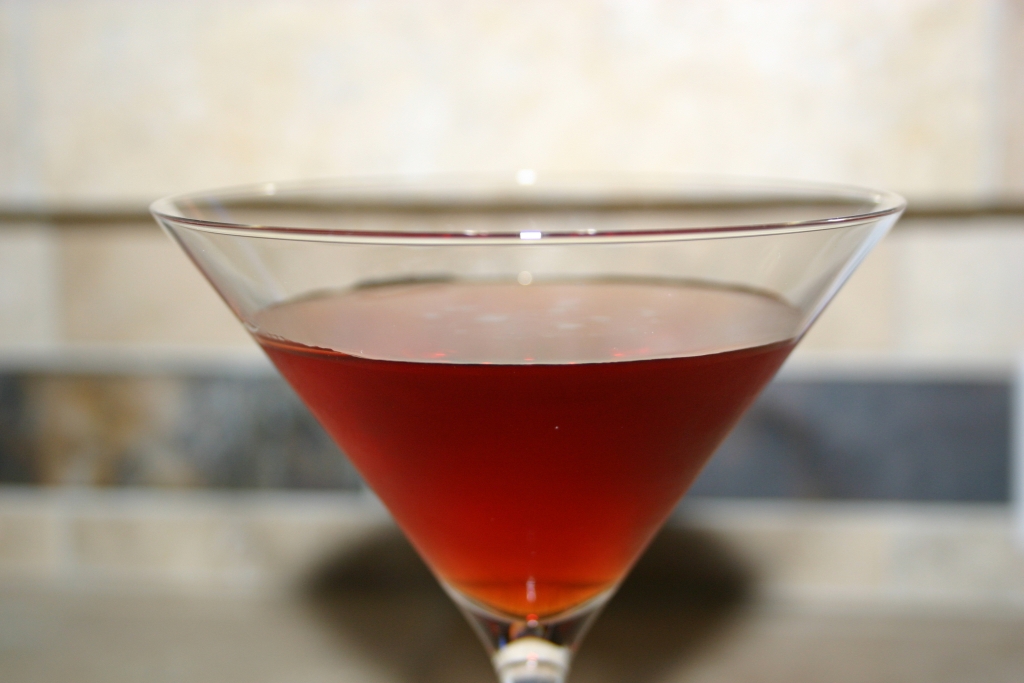
The Negroni turned out to be just such a cocktail. Using the 1:1:1 classic recipe you end up with a cocktail that has great flavor, a nice level of bitterness and perfect balance. Were I simply looking for a good recipe for this cocktail I would happily stop here. I, however, was on a mission for a great recipe. So I continued my hunt. I next tried a recipe I had found in a thread on eGullet, the Cinnabar Negroni as served at Cinnabar in Glendale, CA.

Cinnabar Negroni
2 oz Campari

1 oz Gin

1 oz Sweet Vermouth

2 dashes Orange Bitters

This too is a good recipe, and strangely isn’t too bitter from the additional Campari. The addition of orange bitters, Regan’s in my case, didnt’ seem to add much in this recipe. It did,however, give me the idea to try them with the classic recipe. What I found out from this subsequent experiment is that orange bitters truly make this cocktail. You can really taste them with the decreased Campari and they add a wonderful citrusy complexity to the drink. Another recipe I tried was described as a Smoother Negroni in the eGullet thread.

Smoother Negroni
2 oz Gin

1 oz Sweet Vermouth

1/2 oz Campari

This is, doubtless, a very good cocktail, but I don’t think I can really call it a Negroni. When you’ve increased the Gin so much and decrease the Campari comparably the resulting cocktail is fundamentally different. Seems that Gary Regan had similar feelings with his modified Negroni that he thus renamed the Valentino.

Gary Regan's Valentino
2 oz Gin

1/2 oz Sweet Vermouth

1/2 oz Campari

Each recipe that I tried was very good, but I kept coming back to the classic recipe as my hands down favorite. I do make the aforementioned change of adding orange bitters which I think really heightens this cocktail. As for shaking versus stirring I found that the flavor is the same either way. You may get a touch more dillution with shaking from the ice particles, but the main difference you’ll notice is the appearance. The shaken cocktail is quite cloudy and remains so for a while after serving. Because of this, a stirred Negroni is my choice. Finally, you can serve this cocktail up or on the rocks. I think the up version is a more elegant cocktail, but if the bitterness is too bold for you initially try it over ice and let it dilute a bit. I think you’ll be pleasantly surprised. With those notes I present our version of this cocktail.
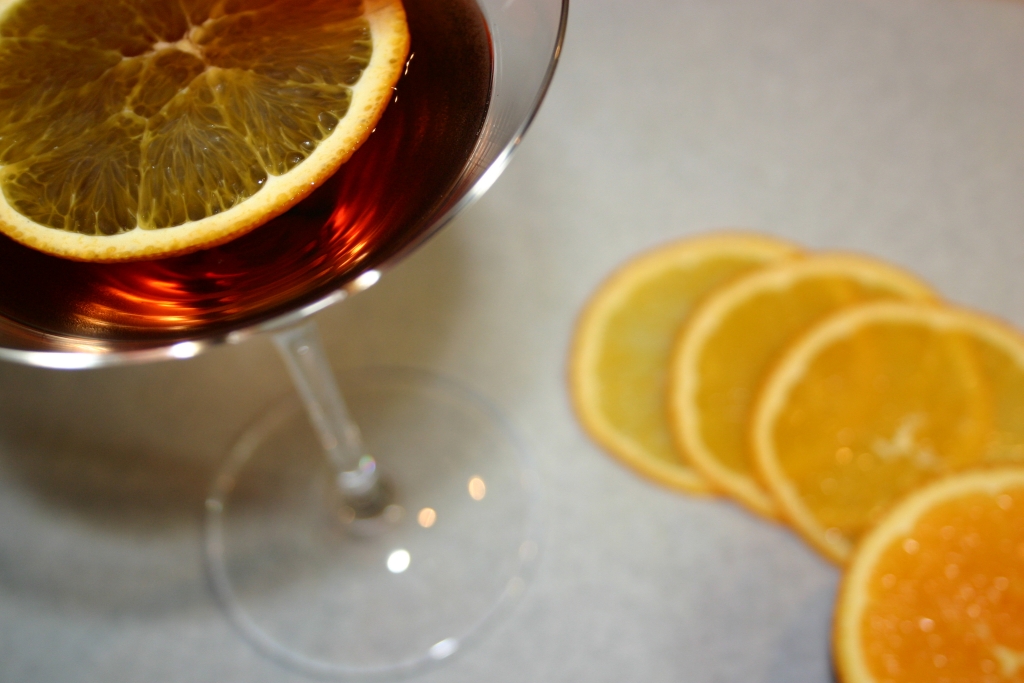
The Cocktail Hacker Negroni
[Ingredients]
1 oz Gin

1 oz Sweet Vermouth

1 oz Campari

2-3 dashes Regan's Orange Bitters
[Directions]
1) Combine ingredients in shaker bottom or pint glass

2) Stir until well chilled

3) Strain into a cocktail glass

My other focus for the week was garnishing. I tried a technique I read about in “The Joy of Mixology” by Gary Regan. The technique called for zesting a lemon (orange in my case) and lining a cocktail glass with the resulting zest. It looked like a good plan in the preliminary stages, but when I added the cocktail the zest floated and messed up the look. Not sure how to correct this, but I’ll have to try again with another cocktail. The other garnish I tried, and loved, was to use a v-slicer to cut very thin slices of orange and float one on the top of the cocktail. I really like the look of this garnish and if you get an orange with a not too bitter pith you can eat the whole thing, which is fantastic. The one garnish that was recommended that I didn’t get a chance to try was flamed orange zest. It’ll have to be next time.
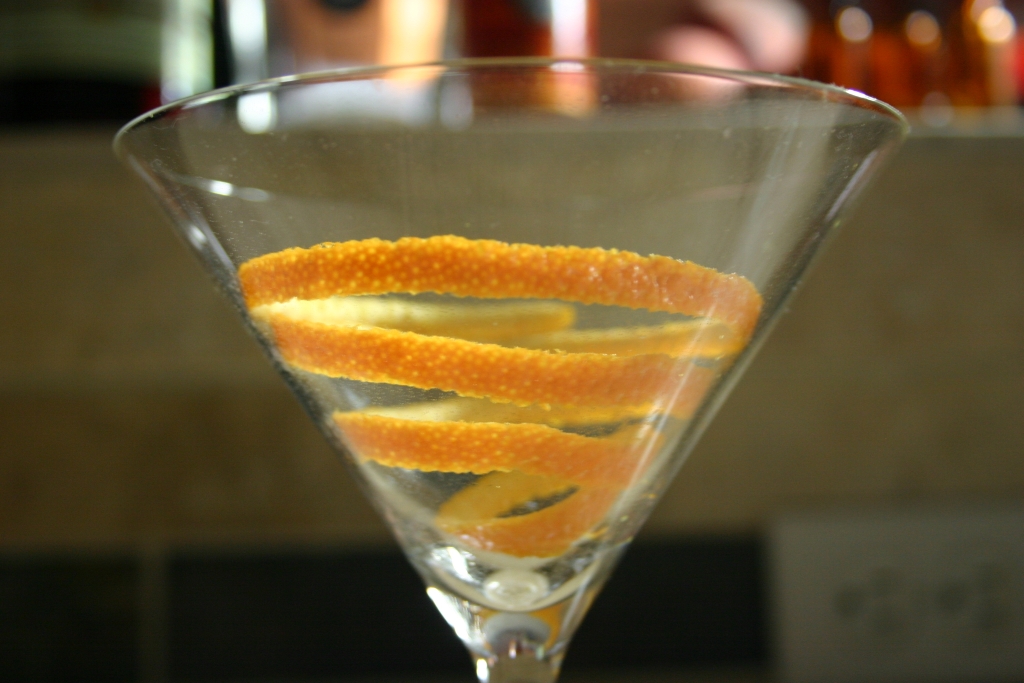
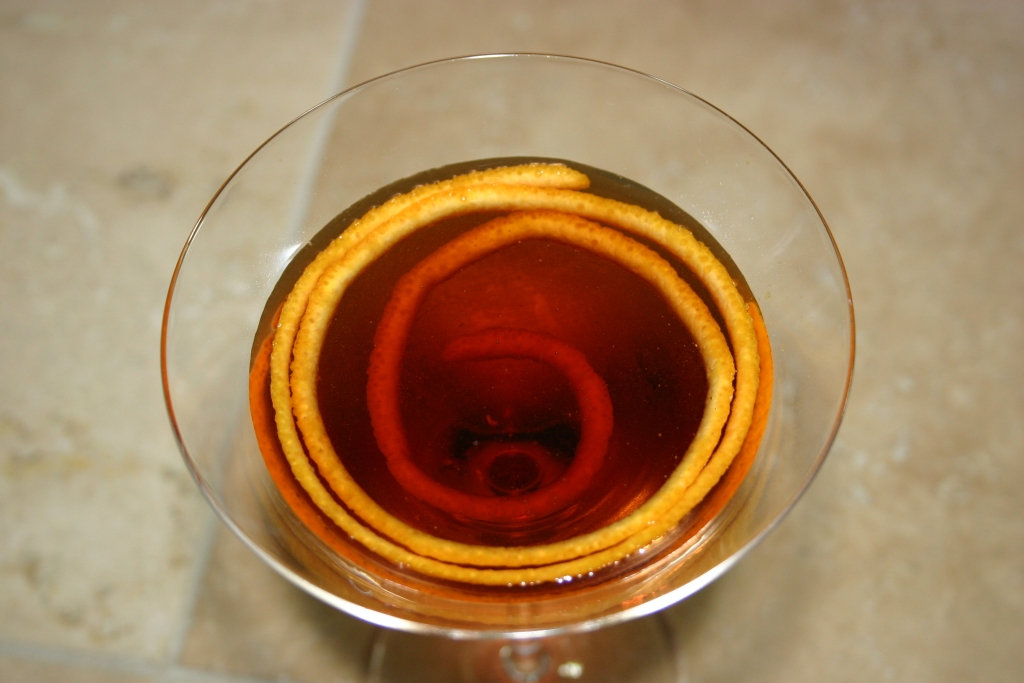
So, despite my initial thoughts that this may be the first cocktail on the site that I didn’t like, I found another gem. This cocktail is colorful, has great flavors and is wonderfully complex. I can easily say that it is well worth a trip to the liquor store for a bottle of Campari. I took a ton of pictures this week and they’re all posted in the Flickr pool.

The Negroni

Posted by Reese On September - 7 - 2008

This week we’re going to highlight a cocktail and ingredient you may have never heard of. Namely the Negroni and its bitter component Campari. The Negroni was created in Florence, Italy in 1919 when Count Camillo Negroni asked to have Gin added to his Americano. And, well, that’s about all the history I could find on the cocktail so, let’s get started with the drinking.

There are lots of recipe variants for this cocktail but we’re going to start our study with the classic.

Negroni
[Ingredients]
1 oz Gin

1 oz Campari

1 oz Sweet Vermouth
[Directions]
1) Combine ingredients in a shaker with ice

2) Shake to chill

3) Strain into a cocktail glass

A Tearful Goodbye to the Whiskey Sour

Posted by Reese On September - 6 - 2008

I’ve spent this week experiencing the nuances of the Whiskey Sour and it is with more than a bit of reticence that we must move on. This cocktail in its many forms is truly wonderful. I’ve tried all manner of combinations this week and can really say I’ve enjoyed them all.

With and without egg white being the first. Does the egg white add something? Most definitely. It adds a silkiness to the mouth feel of this drink that is not attainable any other way. Beyond that it adds uniqueness. I assure you that if you serve a cocktail to a friend with this rich foam floating on top and explain its creation they will be awed. Is the egg white required? Absolutely not. Although it adds a lot to the texture of the drink it doesn’t really do anything for the flavor. So, give it a go both ways and decide what you like. Although, as I mentioned earlier in the week older egg whites may give your cocktail some fridge funk flavor, so buy some fresh eggs for this.

My next big change was to switch up the base spirit. I tried bourbon, rye, a bourbon/rye mixture, and even single malt scotch. Which was the best? Well…that’s not so easy. They all have their strong points. The bourbon gives the drink a sweet smoothness, the rye a spiciness and the scotch smokiness. Not surprisingly what each lends to the cocktail is the strong points of the flavor profiles of each spirit. So again I have to be vague in my suggestion. Use the whiskey that you like best and you’ll be supremely happy with the results.

Finally the bitters, sugar and lemon. Some of the recipes, most in fact, didn’t call for bitters at all. I feel this is an error. Bitters really bring out the flavor of whiskey, but you have to be careful, too much and they can smother those flavors just as easily. My favorite recipe, which is below, uses Fee Brother’s Bitters and Regan’s Orange Bitters together. I really like the spices that the Fee Brother’s Bitters offer more than Angostura in this application and I feel the Regan’s Orange Bitters play extremely well with the lemon juice. The recipe we started the week with called for 1/2 ounce of rich syrup, or the equivalent of 1 ounce of simple syrup. The resulting cocktail was too sweet for my tastes. My final recipe reduces the sugar to 1/2 ounce of simple syrup. Finally the lemon. I didn’t change a thing. This ratio to the base spirit I think is perfect. The only thing I’ll emphasize here is to use the freshest lemon juice you can. If you can’t or don’t want to fresh squeeze juice for every cocktail squeeze a bunch a the beginning of the week and keep it refrigerated. It won’t be as good as supremely fresh squeezed juice but it will be a damn sight better than the stuff from concentrate.

So now I present to you my final Whiskey Sour recipe. Do with it as you please and by all means, Hack It!

Cocktail Hacker Whiskey Sour:
[Ingredients]
2 oz Whiskey (Your Choice)

1 oz Lemon Juice

1/2 oz Simple Syrup

1/2 Fresh Egg White

1 Dash Fee Brother's Old Fashioned Bitters

2 Dashes Regan's Orange Bitters
[Directions]
1) Combine ingredients in a shaker without ice

2) Shake for 10-20 seconds to foam egg white

3) Add ice to shaker

4) Shake until thoroughly chilled

5) Strain in to an Old Fashioned Glass

Whiskey Sour #2 – Difford’s Guide #7

Posted by Reese On September - 2 - 2008

This recipe was my introduction to the world of the Whisk(e)y Sour and I must say I am most certainly a fan. I like the way that the cocktail is noticably sour without being unpleasantly so. Same goes for the sweetness. The bitters are good, but as with the Manhattan I change it up a bit by adding some the Fee Brother’s Bitters. I like the cinnamon notes that they bring to the party. For bourbon I mixed up a number of these for my family this weekend using Woodford Reserve bourbon which was quite nice although I miss the spiciness of some of the other bourbons. I had contemplated using Bulleit as their recipe includes a bit more rye increasing the spiciness. I wanted to try a new bourbon though, so I went with the Woodford. To spice it up I tried using 1 oz of bourbon and 1 oz of rye (Wild Turkey) and the result was quite nice.

I have a few other notables to mention while we’re discussing this recipe. One, make sure you shake the cocktail dry (eg without ice) first for about 20 seconds, then shake again with ice. This allows the egg white to froth up more and gives the end cocktail a smoother mouth feel. On the topic of eggs, make sure to use the freshest eggs you have. I made one cocktail with some eggs that had been in my fridge for a couple weeks and you could really taste the flavors that the fridge imparted (which was not so tasty). The recipe also calls for rich syrup (2 sugar : 1 water) but you could use simple syrup (1 sugar : 1 water) by simply doubling the quantity. This however, will dilute your cocktail slightly more and may throw off the flavors.

Overall this recipe has set the bar for the Whiskey Sour quite high. Finding a better recipe may be nearly impossible. But fear not good readers! For we will continue our explorations and report back to you.